Hardwigg Gives Harry His Last Water
A Journey to the Centre of the EarthHardwigg Gives Harry His Last Water is a moment of care at the junction of the underground galleries, where Professor Hardwigg gives Henry the final mouthful in his bottle after hours of crawling have left him almost unable to move. The water does not end the explorers’ danger, but the Professor’s deliberate sacrifice makes their familial bond newly visible: the man who has resisted Henry’s objections to his theories has quietly kept his own thirst in check for the sake of his nephew’s survival.
Circumstances at the Junction
On Tuesday, July 7, after crawling for many hours on hands and knees, Henry, the Professor, and Hans reach the point where the galleries join. They are more dead than alive. At ten in the morning Henry lies inert on the arid lava soil, his lips scorched and swollen, while Hans and the Professor lean against a wall and try to nibble pieces of biscuit. Henry’s physical collapse gives the scene its urgency: he is not merely thirsty, but so depleted that he falls into a deep lethargy.
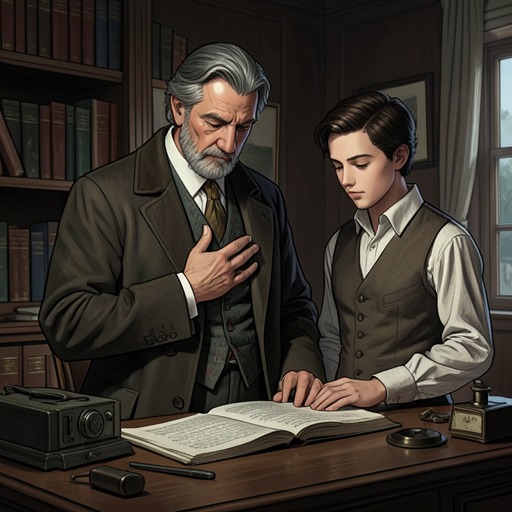
The Professor approaches and lifts Henry tenderly into his arms. Henry is struck by the gesture because he is not accustomed to signs of such tenderness from his uncle. The change is registered through precise, reciprocal actions rather than explanation: Henry takes the Professor’s trembling hands and gently presses them, and the Professor allows him to do so while looking kindly at him. His eyes are wet with tears. The encounter briefly interrupts the expedition’s harsh physical routine with a direct expression of attachment.
The Last Mouthful
The Professor takes the gourd at his side and places it to Henry’s lips. He tells him to drink. At first Henry can hardly accept what is happening; he fears that his hearing has deceived him and that hope will give way to disappointment. Before he can question the offer, however, a mouthful of water cools his parched lips and throat. It is only one mouthful, but Henry believes it brings him back to life.
The Professor then identifies the cost of the gift: the water is the very last in his bottle. He says that he has guarded it carefully and repeatedly resisted the powerful desire to drink it himself. He kept it for Henry. The act is therefore not an incidental sharing of supplies but a choice made under scarcity, in which the Professor has preserved a resource for the moment his nephew would need it most.
Foresight and Sacrifice
The Professor explains that he expected Henry to reach this crossroads in the earth half dead. He saved the final drop specifically to restore him there. That explanation gives the earlier restraint a purpose: the Professor had anticipated Henry’s collapse and planned around it, holding back water through his own thirst rather than consuming the reserve. The junction is at once a physical meeting point in the passages and the place where his private preparation becomes legible to Henry.
The gift cannot quench Henry’s thirst altogether. Its immediate consequence is more limited but still vital: his throat’s contracted muscles relax, the inflammation of his lips subsides somewhat, and he regains enough strength to speak. Henry answers first by clasping his hands in gratitude, unable to speak because his heart is too full; once his voice returns, he thanks his uncle. The scene moves from physical incapacity to partial recovery, without pretending that one mouthful has solved the larger crisis.
A Changed View of the Professor
The tenderness of the rescue stands in contrast to the Professor’s usual confidence and reserve. Earlier, Henry argues that established scientific teaching makes a journey to the earth’s interior impossible, citing the expected increase in heat with depth. The Professor dismisses theory as a reason to abandon the expedition. Elsewhere, he speaks with authority about the signs by which an imminent volcanic eruption might be judged, insisting that the signs indicate no immediate danger. These disputes establish a man who trusts his own conclusions and expects resistance to yield to evidence—or to his decision.
Henry’s memory of the water scene emphasizes how unusual the Professor’s open tenderness is to him. Yet the gesture does not undo their disagreements or resolve their scientific debate. Instead, it reveals another dimension of their relationship: beneath the Professor’s forceful manner lies a readiness to endure deprivation for Henry, expressed not as argument but as a saved gourd and a mouthful offered when Henry can scarcely respond. His eyes, hands, and the water make care visible before either man can put it fully into words.
The Scene’s Place in the Expedition
The rescue occurs at a consequential point in the underground journey, after the explorers have struggled through the galleries and just as they reach a junction. Henry’s return to speech allows the narrative to move beyond the immediate image of his collapse; the surviving water has served its purpose, though it has also been spent. The episode makes the expedition’s bodily stakes concrete: biscuit is scarce, water is nearly gone, and even a single mouthful can mark the difference between helplessness and the ability to continue communicating.
The scene also modifies the expedition’s pattern of authority. The Professor’s confidence in scientific judgment remains part of his character, but his care for Henry is conveyed by a different kind of knowledge: he has understood that his nephew will fail at this particular place and saved what he could for that contingency. Henry’s gratitude and the Professor’s tears briefly make their bond more legible than their disputes. The journey remains perilous, but at the crossroads the Professor’s last reserve becomes an act of kinship, and Henry’s weakened body becomes the measure of what that kinship costs.